- The Public Health Sudbury & Districts catchment area is home to over 24 0003 Indigenous Peoples (13%), comprised of First Nations (North American Indians) (57%) and Métis Peoples (40%).4 A small subset of the Indigenous population identifies as Inuit or as having multiple Indigenous identities (3%).4
- Anishinaabemowin (Ojibwe language) is the Indigenous language most spoken in the area.4
- The Indigenous population is younger than the non-Indigenous population in Greater Sudbury, and the Sudbury and Manitoulin districts.4
- Indigenous Peoples live in both urban settings and in the area’s thirteen First Nation communities, with a total population of 6 3793 living on-reserve.
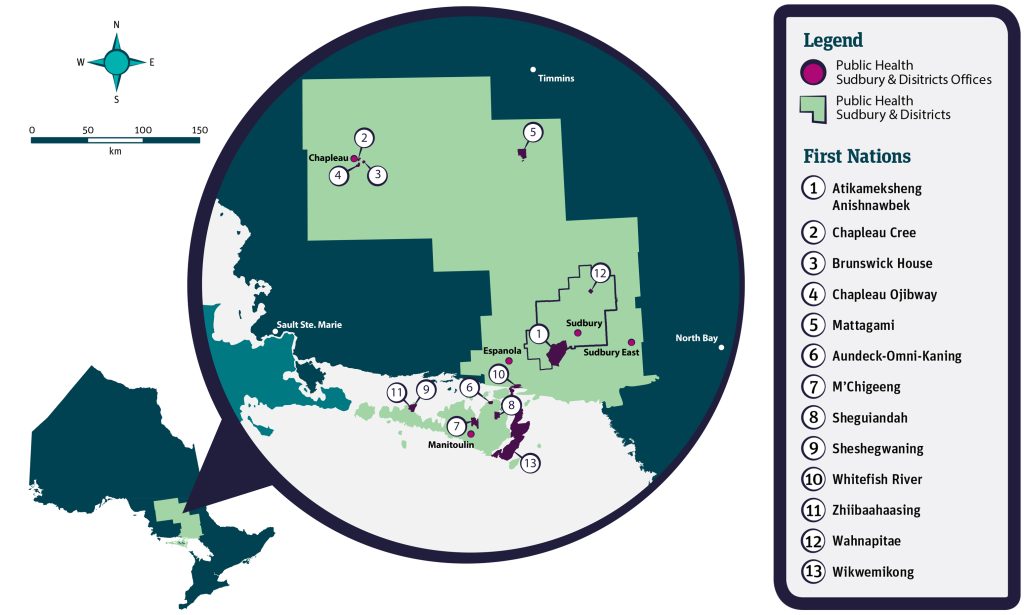
- Five First Nations are in the Sudbury district, one in Greater Sudbury, and seven are located on or near Manitoulin Island.
- First Nations in this region are signatory to Treaties 9 and Robinson Huron, and belong to one of five Tribal Councils. Wiikwemkoong First Nation remains an unceded territory.
Reference: 3 Statistics Canada, 2016 Census
Reference: 4 Registered Indian Population by Sex and Residence 2016, Indigenous and Northern Affairs Canada; and 2016 Census, Statistics Canada, 25% Sample
13 First Nations within Public Health Sudbury & Districts’ service area
Each First Nation community is unique, with different demographics, needs, resources, assets, and challenges.
Métis groups within Public Health Sudbury & Districts service area
The Métis Nation of Ontario has an office in Sudbury serving Métis citizens in and around Greater Sudbury as well as Chapleau with whom we work.
This page was last updated September 3, 2026