
Across our service area nearly 1 in 5 households are food insecure. This means that these households have inadequate or unreliable access to food because of a lack of money. Food insecurity is a serious public health problem. It impacts physical and mental health1.
Some households are more likely to experience food insecurity than others. Food insecurity is more common in households that:
- rely on social assistance for example, Ontario Works or the Ontario Disability Support Program
- rent rather than own their home
- are female one-parent led.
Each year, Public Health Sudbury & Districts surveys the price of a variety of food items from 10 local grocery stores. This survey is called the Ontario Nutritious Food Basket (ONFB). The ONFB is used to see how affordable food is by comparing the cost of the food basket and housing to various household income scenarios.
The 2025 results indicate that some households must make the choice between eating and paying for other core living expenses.
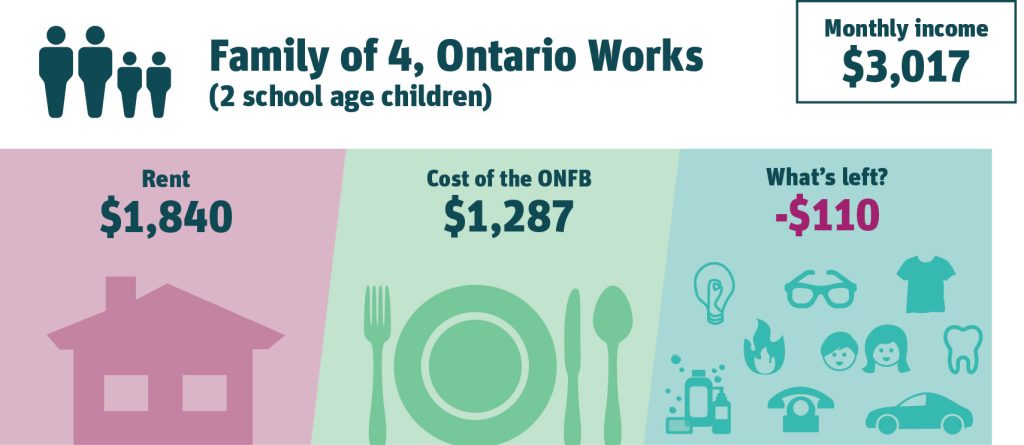
Family of 4, Ontario Works (2 school age children). Monthly income $3,017. Rent $1,840 (61% of income). Cost of the ONFB $1,287 (43% of income). What’s left? -$110.
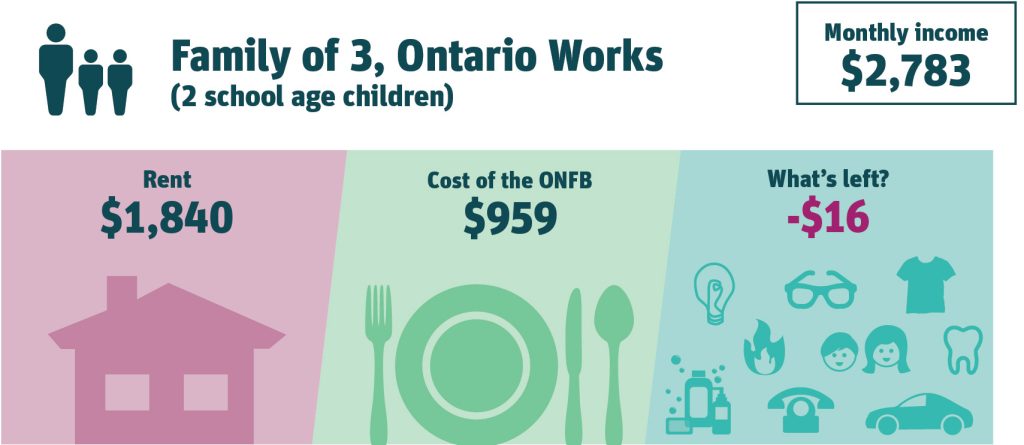
Family of 3, Ontario Works (2 school age children). Monthly income $2,783. Rent $1,840 (66% of income). Cost of the ONFB $959 (34% of income). What’s left? -$16.
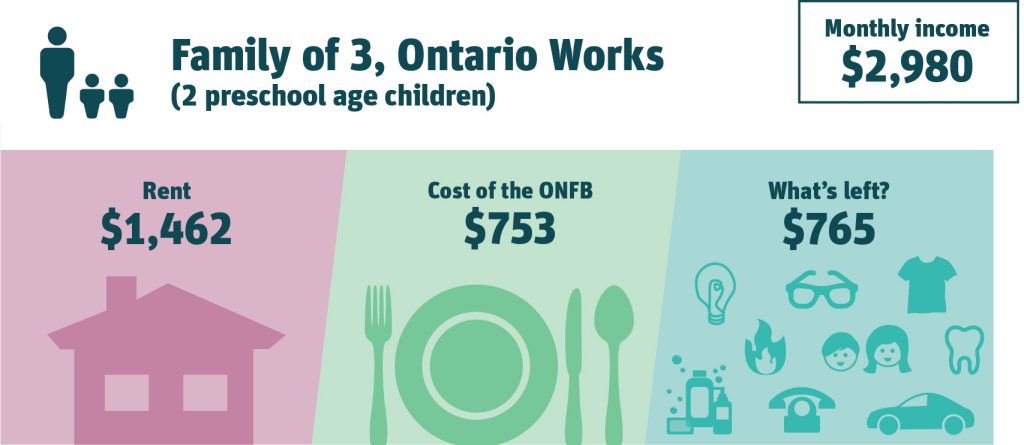
Family of 3, Ontario Works (2 preschool age children). Monthly income $2,980. Rent $1,462 (49% of income). Cost of the ONFB $753 (25% of income). What’s left? $765.
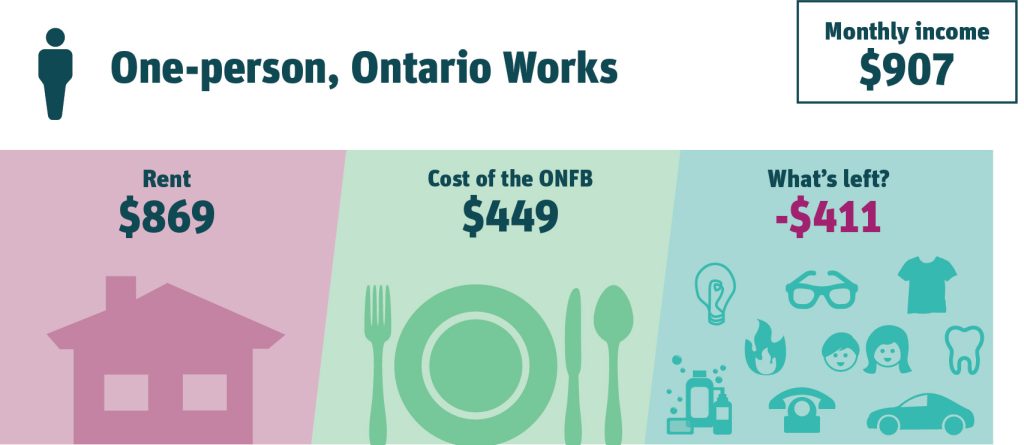
One-person, Ontario Works. Monthly income $907. Rent $869 (96% of income). Cost of the ONFB $449 (50% of income). What’s left? -$411.
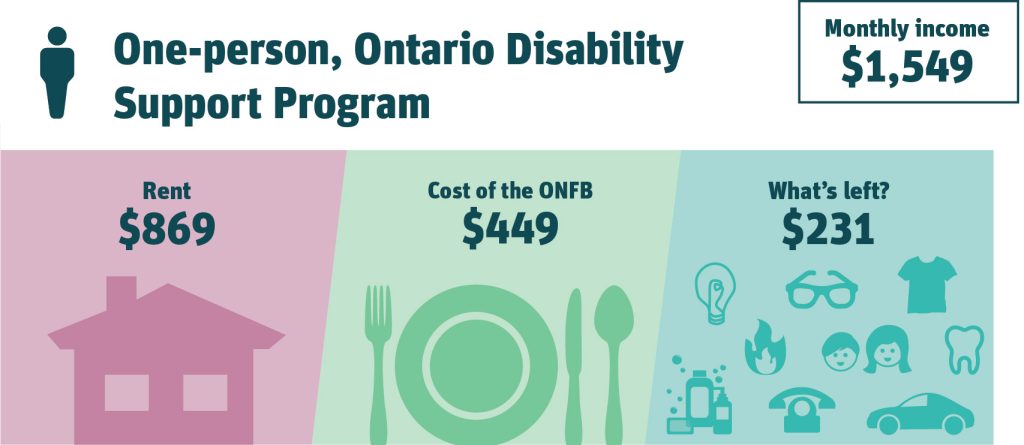
One-person, Ontario Disability Support Program. Monthly income $1,549. Rent $869 (56% of income). Cost of the ONFB $449 (29% of income). What’s left? $231.
What can be done?
The root cause of food insecurity is poverty. Charitable food programs such as food banks are our primary response to food insecurity. However, charitable food programs do not address poverty. We need a sustainable income solution to this problem2.
We can do this by:
- learning more about
- what can be done to reduce food insecurity in Canada (PROOF)
- structural determinants of health (Keeping it political and powerful: Defining the structural determinants of health, National Collaborating Centre for Determinants of Health)
- supporting
- a basic income guarantee (Basic Income Canada Network)
- an adequate increase in social assistance rates
- a minimum wage rate that aligns with the cost of living
- access to community tax clinics to ensure everyone receives all the benefits they deserve
Resources
More information about food insecurity can be found by visiting the following resources:
- PROOF
- Ontario Dietitians in Public Health’s position statement and recommendations for responding to food insecurity
- Basic Income Canada Network
Contact us for more information on food, food insecurity, nutrition, and healthy eating.
References
1 Li T, Fafard St-Germin AA, Tarasuk, V. (2023) Household food insecurity in Canada, 2022. Toronto: Research to identify policy options to reduce food insecurity (PROOF) PROOF – Identifying policy options to reduce household food insecurity (utoronto.ca)
2 Ontario Dietitians in Public Health. (2020). Position Statement and Recommendations on Responses to Food Insecurity. Retrieved from: https://www.odph.ca/odph-position-statement-on-responses-to-food-insecurity-1