
Public Health Sudbury & Districts plays a key role in the development and delivery of evidence-informed public health programs and services.
How do we generate evidence?
- We use existing planning processes and consultation across the agency to identify gaps in knowledge and evidence and to prioritize areas and topics about which we should consider generating evidence.
- We generate evidence by:
- conducting research,
- evaluations,
- needs assessments,
- literature reviews;
- and engaging with the public and community stakeholders.
- This is often done in partnership with other public health units and with community researchers and academic partners.
Contact our Effective Public Health Practice team for more details on our Program Planning Framework and our tools.
ephp@phsd.ca
Program Planning Framework
It’s a guide
The planning framework is a standard framework to guide the assessment, planning, implementation, and evaluation of our work in public health.
It’s flexible
Tools exist within the cycle to assist you with planning. Contact us to learn more about our tools.
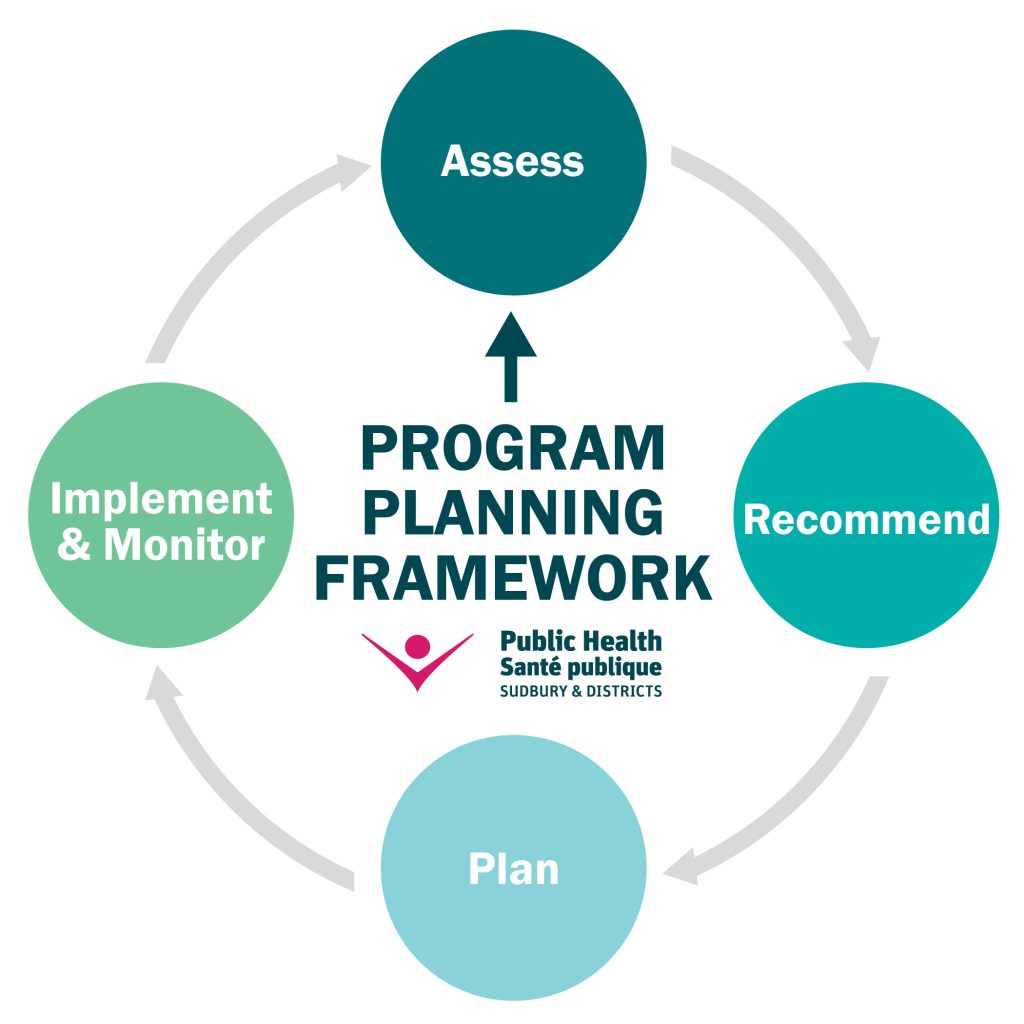
1. Assess
- Define the issue or problem
- Learn how to define your issue/problem with the Evidence-informed Public Health video (National Collaborating Centre for Methods and Tools).
- Review, synthesize, and document evidence of need and effectiveness.
- Identify target and priority populations.
- Consider valuable evidence from a variety of sources (PDF, National Collaborating Centre for Methods and Tools).
- community health and local context
- existing public health resources
- community and political climate
- population health data
- best available research findings
- evaluation data from previous cycle
- Incorporate community engagement strategies.
- Consult with collaborating managers and teams.
2. Recommend
- Synthesize the evidence and draw conclusions; recommend interventions based on need, impact, capacity, and partnerships.
- Synthesize the evidence and draw conclusions; recommend interventions based on need, impact, capacity and partnerships
- Rely on public health expertise to integrate all relevant factors into any decision making.
- Identify priorities and make program decisions.
3. Plan
- Develop planning deliverables to suit operational needs. These may include:
- a logic model
- include goal, approaches, audiences, and outcomes
- activity or program plan
- Include program and intervention descriptions, objectives, indicators, activity details, and evaluation and quality improvement plans.
- the Annual Service Plan for the Ministry of Health
- a logic model
4. Implement and monitor
- Deliver the program and interventions.
- Collect, analyze, and monitor indicator, evaluation, and quality improvement evidence.
- Determine what program and/or intervention modifications should be made.
- Report on progress as required (for example mid-year, year-end).
- Compile any gaps, practice-based questions, and research priorities for the next cycle.
This page was last updated June 23, 2026